
 |
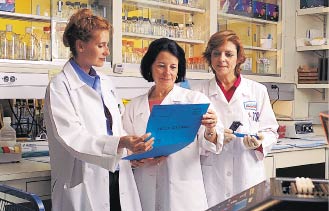
Promising epidemiology research includes projects focusing on the role of diet in the risk of prostate cancer. Dr. Sara S. Strom, (center) and Dr. Patricia Thompson (left), both assistant professors of epidemiology, work with Dr. Randa El-Zein, a postdoctoral fellow, in evaluating dietary nutrients. |
 The
foundation for curing prostate cancer is being built on research.
The
foundation for curing prostate cancer is being built on research.
Through
the Prostate Cancer Research Program, scientists and physicians at M.
D. Anderson are discovering clues to better understand the biology of
the disease, to strengthen therapy for all stages and to design sound
prevention strategies.
“The
broad spectrum of translational research conducted here is unmatched.
New knowledge resulting from the revolution in cancer biology and molecular
biology has produced unprecedented possibilities for advancing clinical
care and, most importantly, improving the cure rate,” explains Dr.
Isaiah J. Fidler, chairman of the Department of Cancer Biology, director
of the Cancer Metastasis Research Center and co-director of the PCRP.
Dr.
Fidler, who holds the R. E. “Bob” Smith Distinguished Chair
in Cell Biology, says cancer metastasis — or the spread of malignant
cells from primary tumor sites via the lymphatics and bloodstream to other
parts of the body — is the life-robbing villain for approximately
100 American men who now die every day from the disease.
Yet
he is “encouraged” by research among PCRP collaborators and
the accelerating application of new findings to patients. Among his examples
are:
• Developing relevant animal models in which human prostate cancer cells that have metastasized to other organs can be analyzed. Using so-called athymic mice, scientists inject human prostate cancer cells into the animals’ prostates, then evaluate the biological differences between tumors that metastasize from those that do not. Recent findings should help clinicians better predict which prostate tumors are most likely to spread, particularly to patients’ lymph nodes and/or bone.
• Demonstrating through examining surgical specimens taken from patients that specific genes account for the metastatic process. Genes that affect cell cohesion, cell invasion and prevent angiogenesis — or the formation of new blood vessels — were studied and data applied to clinical ability to forecast metastatic disease. This research was led by Dr. Curtis A. Pettaway, assistant professor of urology, in concert with Dr. Hiroki Kuniyasu, a visiting Japanese pathologist in the Department of Cancer Biology.
• Expanding efforts to inhibit angiogenesis, which is required for tumors to grow and spread. Scientists have shown that one type of interferon can decrease the number of new blood vessels formed as cancer cells multiply in laboratory animals. This research involving daily injections of low-dose interferon-beta documented that the protein could “turn off” the angiogenesis process. A clinical trial will start soon to assess the value of giving the biologic agent to patients with prostate cancer.
Dr.
Fidler also cites collaborative research to identify and isolate growth
factors and their receptors as a means of interrupting cancer cell proliferation
and hastening the design of better targeted methods to treat prostate
cancer.
Other
promising research studies in epidemiology and genetics are coordinated
by Dr. Margaret R. Spitz, who chairs the Department of Epidemiology and
holds the Olga Keith Wiess Chair for Cancer Research. She is heartened
by these investigations:
• Several projects coordinated by Dr. Sara S. Strom, assistant professor of epidemiology, whose group is studying the role of diet in the risk of prostate cancer. Early findings suggest that men who eat high-fat diets are more likely to develop the disease than men who follow diets rich in plant- derived nutrients known as phytoestrogens. Changes in body fat distribution will be charted over long periods.
• Broadening attention to the possible roles of race, economic status, patterns of baldness and history of vasectomy in the development and spread of prostate cancer. Accumulating data also indicate that men who smoke may be more susceptible.
• Fruitful research focusing on correlating genetic and environmental factors with clinical outcomes. M. D. Anderson scientists have been leaders in showing that prostate cancers occur in families. Dr. Jacob Kagan, assistant professor of laboratory medicine, and colleagues also are closing in on identifying and cloning tumor suppressor genes that can interrupt the prostate cancer process.
• Findings from research coordinated by Dr. Sue-Hwa Lin, associate professor of molecular pathology. She has demonstrated how the C-CAM1 molecule on the cell surface helps cells adhere to each other and shown that the molecule also may have a role in suppressing tumor growth. Such studies should lead to a specific marker for improving diagnosis and treatment of prostate cancer.
• Encouraging results from research led by Dr. Timothy J. McDonnell, associate professor of molecular pathology, who focuses on understanding the factors associated with regulating apoptosis or cell death. His work centers on the bcl-2 gene, which seems to prevent tumor cells from going through apoptosis. Through animal studies, he hopes to help develop more effective therapy for the worst recurrences of prostate cancer.
“These
kinds of laboratory and population studies aim to unravel the molecular
mysteries of prostate cancer and provide a scientific basis for its ultimate
prevention. Meanwhile, we are learning how to better predict which patients
will develop virulent disease that should be aggressively treated,”
Dr. Spitz says.
