FRONTLINE
Beam-Shaping Device On Target
-
- If one word could best describe a new device that can treat small,
irregular-shaped brain tumors, it would have to be innovative.
-
- The computer-controlled miniature multileaf collimator (MMLC), developed
and patented in the Department of Radiation Physics at M. D. Anderson,
is the latest weapon in stereotactic radiotherapy and radiosurgery.
-
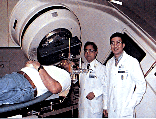 Using a miniature multileaf collimator, Dr.
Almon S. Shiu (left) and Dr. Lei Dong are able to more precisely conform the
radiation dose delivered to small tumors of virtually any shape while avoiding
damage to nearby normal tissue.
Using a miniature multileaf collimator, Dr.
Almon S. Shiu (left) and Dr. Lei Dong are able to more precisely conform the
radiation dose delivered to small tumors of virtually any shape while avoiding
damage to nearby normal tissue.
- The MMLC's ability to shape individual treatment fields to fit the
precise dimensions of a well-defined target specified by the radiation
oncologist and neurosurgeon is its greatest asset.
-
- "It allows us to conform the radiation dose delivered to tumors
of virtually any shape while avoiding nearby normal tissue and critical
structures such as the optic nerves and optic chiasm," says Dr. Almon
S. Shiu, assistant professor of radiation physics. "With conventional
linear-accelerator circular collimators, the treatment of non-spherical
tumors affects a larger proportion of healthy brain."
-
- There are several advantages to the MMLC, including:
-
- · Decreased brain toxicity.
-
- · Finer resolution. The MMLC uses four millimeters of resolution
versus 10mm for traditional multileaf collimators. "The former resolution
is better for irradiating small, irregular malignancies, particularly those
that lie close to sensitive areas in or near the brain," says Dr.
Kenneth R. Hogstrom, chairman of the Department of Radiation Physics.
-
- · Greater flexibility in altering the pattern of beam delivery.
-
- · Improved field shaping capabilities, allowing conformal therapy
to both convex and concave targets.
-
- · Use of a single isocenter (point in patient to which all radiation
beams are focused) to deliver treatment fields. To conform to a non-spherical
tumor using standard technology, two or more overlapped spherical treatment
volumes, each having its own isocenter, are needed.
-
- "This leads to hot areas within the overlap region and a high
brain dose, which increases the likelihood for complications," Dr.
Shiu explains. "Therefore, an MMLC approach is most desirable."
-
- Radiation oncologist Dr. Moshe H. Maor, Dr. Shiu and their team are
enrolling patients to test a prototype of the MMLC, with two patients having
received treatment thus far.
-
- Through a licensing agreement between M. D. Anderson and Radionics
Software Applications, Inc., a commercial MMLC based on the cancer center's
design is currently being manufactured and is expected to be available
late fall.
-
- The Radionics version will have a larger field size, expanding the
treatment areas to the prostate and head and neck.
-
- Through the ingenuity of co-inventors Dr. Shiu, James Ewton, Henry
Rittichier, Shih-Ming Tung, Jeremy Wong and Dr. Lei Dong, and support from
the Texas Higher Education Coordinating Board, the MMLC gives patients
one more chance in their fight for a cure.
-
- -- Eileen A. Ellig
Return to Summer 98