

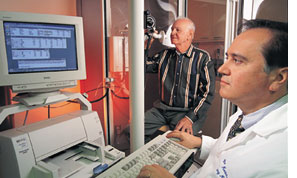
 Dr. Rodolfo C. Morice
measures lung capacity
for Pearley Brown,
a patient from
Orange, Texas.
More than 15 percent of the approximately 1,000 neurosurgical procedures performed at M. D. Anderson during the past fiscal year were for patients 65 and older, reports Dr. Raymond E. Sawaya, chairman of the Department of Neurosurgery.
“Our
volume of older patients is increasing, too. Statistics show that in general
older patients undergoing brain surgery have about the same neurological
outcomes as younger ones,” says Dr. Sawaya, who holds the Mary Beth
Pawelek Chair in Neurosurgery.One
of the oldest patients was a 93-year-old attorney whose malignant skin cancer
of the scalp was causing weakness and spreading into his brain. Dr. Franco
DeMonte, an associate professor of neurosurgery, orchestrated the removal
of the tumor and sent the patient home two days later to enjoy Thanksgiving.Dr.
DeMonte, who specializes in skull base tumors, has removed large benign
brain tumors from several patients 80 and older. In most cases, the tumors
had been pressing on vital brain tissues and producing progressive weakness
and inability to walk. One of those patients is an 84-year-old Louisiana
man who regained his balance and walked out of the hospital following excision
of a giant acoustic neuroma. Many
patients of all ages — including those in their 80s and 90s —
benefit from extensive rehabilitation following brain surgeries and other
aggressive treatments. The Pennzoil Rehabilitation Services area provides
a centralized location for both hospitalized patients and outpatients to
work on overcoming mobility, strength and cognitive problems. “We
are seeing an increasing number of senior patients, including some in their
90s, whose primary treating physicians want us to help restore physical
function so they can enjoy a better quality of life. For the elderly, it
is so essential to keep them up, mobile and participating in daily activities,
such as personal grooming, cooking, household tasks and interacting with
others,” observes Dr. Theresa A. Gillis, chief of the Section of Physical
Medicine and Rehabilitation.Dr.
Gillis and her colleagues frequently assess neurological function and physical
mobility for older patients prior to undergoing surgery. “We
also must be mindful of medications that the elderly take for underlying
problems since those drugs may interact with chemotherapeutic agents, sedatives
and anesthetics used during surgery. Older patients on chemo may develop
loss of feeling in the extremities and/or muscle weakness, while some patients
having radiation may experience generalized weakness and fatigue. Evaluating
them prior to treatment allows us to prevent or at least minimize some of
the problems,” Dr. Gillis says.Continued